Thursday, April 7, 2016

Literary Miximals with Elizabeth Rose Stanton

I had so much fun with fellow Whatsit, Ben Clanton's, post about "Miximals" from last week that it got me thinking about some of the "miximals" that already exist in children's literature.
Here are some that spring to mind:

Growing up, I was fascinated by Hugh Lofting's pushmi-pullyu—kind of a gazelle, bi-horned unicorn cross:
from The Story of Dr Dolittle (1920)


Lewis Carroll's fantastic nonsense creatures came to life in John Tenniel's exquisitely detailed drawings:

The gryphon, which looks to be a lion, raptor, not-sure-what-else kind of critter; and the mock turtle— a wonderful blend of cow and turtle!
from Alice's Adventures in Wonderland (1865)


 . . . and the ultimate composite Alice creature, the jabberwocky:
from Through the Looking glass, and what Alice Found There (1871)


On a more modern, and lighter note, here are a few jumbled-up characters from Dr. Seuss, complete with a variety of miximal-type names:


Joats
  from If I ran the Zoo (1950)


Finally, I think Maurice Sendak's Wild Things are some of the best "miximals" going!
 from Where the Wild Things Are (1963)

 What are your favorite miximals from children's literature?

-ERS


Friday, April 1, 2016

Miximals with Ben Clanton

In the last post I did for the whatsit blog (back in November!) I talked about different ways of keeping final art loose and free. My eighth tip for loosening up was about warm-ups. Today I thought I'd share one of my favorite warm-up games. It isn't all that complex, but it tends to be a favorite among illustrators for good reason. I've heard this game called many things, but the one I like best is 'miximals.'


When I play this game at school presentations and book readings I ask the audience for three different animal names. If you do play this game with kids it can be fun to pretend to mishear the suggestion or misremember it. For example, if a kid suggests a 'dog' then I might say 'Emu?! Great idea!' . . . the kids love to shout back what the actual suggestion was. BUT seeing as I do not have an audience in my studio tonight I decided to simply search online for a 'random animal generator' which turned out great. An alternative is to rip up a bunch of paper scraps and write creature names on the different scraps, put them in a bucket, and draw out a few from the bucket. Once you have three animal names or two or ten then the next step is to simply draw a picture of all those creatures mashed together. I find this never fails to get my creative juices flowing. It is both fun and challenging. You can also take it a step further and determine the name for the creature by mixing the names of the creatures.


There is a writing game I enjoy playing sometimes that is similar to maiximals in which I write a bunch of random words down, select a few, and then have to use all those words in either a sentence or a short story. The more words the bigger the challenge and the more interesting the result!

I'd love to see what sort of miximals you come up with!

Sunday, February 7, 2016

Some Meanwhile Thoughts

-Loads of activity going on for THE WHATSITS lately — book launches, new book deals, LOTS of books in the works! Never a dull moment. So hang tight. We'll be back with another scintillating post in a couple of weeks.

Meanwhile, here are some WHATSIT thoughts from each of us:

An upside down thought from Elizabeth Rose Stanton
.

A stellar thought from Wendy Wahman
. 

A two sides to it thought from Kevan Atteberry
.

A racy thought from Ben Clanton
.

An achy thought from Jennifer K Mann
.
See you soon!


Monday, January 4, 2016

Announcing the newest member to the family: Peddles!

by Wendy Wahman

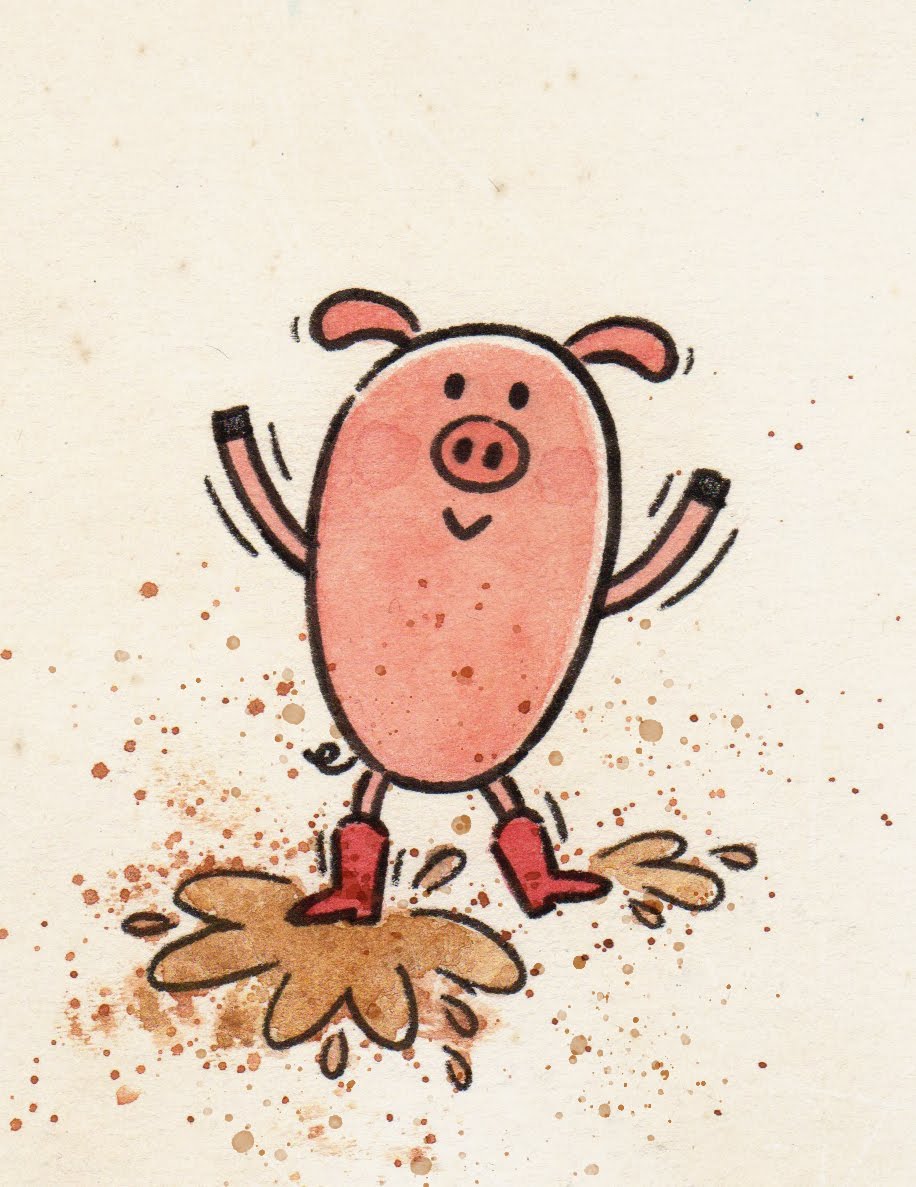
Elizabeth Rose Stanton’s new baby, PEDDLES, debut birthday party is this Friday, and we’re mighty proud and excited around here. But what do you get a pig for his birthday? Well, if you’re the beloved nephew of A Whatsit, you might get a portrait of yourself (and a trough of cake).

If you’re in the Seattle area, join us at University Bookstore, Fri., Jan. 8th at 7pm.
to raise our champagne glasses to our dear, talented, hard working Elizabeth.


~ Check out the Calendar for upcoming PEDDLES and other Whatsits events ~


‘Peddles’ with love from Uncle Ben:

Mama Stanton:


Auntie Jennifer:

Uncle Kevan:


and Auntie Wendy:


 We love you, Peddles!

Tuesday, December 8, 2015

Happy Whatever from The Whatsits

– Wendy Wahman

Should auld acquaintance be forgot, 
And never brought to mind? 
Should auld acquaintance be forgot, 
And auld lang syne.


As we join hands in friendship and look forward to the New Year, we remember old friends and welcome new. And so can be said for work and art. Some oldies but goodies from seasons past: 

Ben Clanton
This guy was an art test for a book I was working on last year called IT CAME IN THE MAIL (coming in June . . . so far away!). Just like getting a parcel in the mail, the first snow always fills me with wonder and a belief in magic.


Elizabeth Rose Stanton

The holidays wouldn’t be the holidays without a little pathos . . . so here’s scene from an almost forgotten story I started a few years ago. Maybe our readers can help complete it.

Wishing everyone a happy, merry, everything!


Jennifer K. Mann
I love the birds that visit my backyard, and their songs are especially alive this time of year. Every year during Advent, I make tiny paintings of the tiny birds in my yard, to slip into the pockets of a cloth advent calendar for my children. Advent occurs during the darkest time of the year, yet these little birds remind me of the light that is just over the horizon. Soon, as always, the darkness will be replaced by the light of spring and new life.


Kevan Atteberry 

This Holiday Hello card is from 2011. It features a couple characters that have popped up in several things I’ve done in the past. I originally thought of them and worked on them a few years before this thinking it might be a comic strip—Two Unlikely Friends. Then I’ve toyed with the idea of using them in a young graphic novel. I’m still thinking about that and I revisit them every now and then. Especially around New Year’s Day for some reason.


Wendy Wahman

I drew these Nutcracker dancers for the Holiday Happenings section of the Seattle P-I newspaper in 2004. I had a whole little family of snow people adorning the event and performance listings. They sailed on the Christmas Ship, played the harpsichord in choirs and took their bows on stage alongside ghosts of Christmas’ past. A few years later, they were the inspiration for SNOWBOY 1,2,3.


Peace, love and good works in the New Year,
Ben, Elizabeth, Jennifer, Kevan and Wendy


Say, speaking of dancers… leaping onto the stage in January, is Elizabeth’s newest picture book, PEDDLES! 


Wednesday, November 18, 2015

Loosey Goosey with Ben Clanton

My favorite part of the book making process is when the book first starts to take shape. I love drawing character sketches and creating that first dummy book. For me it is the most creative part of the process and it is when the book with all its potential has the most life. But then comes final art (a.k.a. FARTS) and I find myself wanting to make the book perfect and struggling to keep the art alive. I tighten up because I want it all to be just so. I imagine this is something that will always be difficult for me, but there are some tips, tricks and general tidbits that I have learned. These are the ones that come to mind . . .


1. LET IT GO!

And now I have that song stuck in my head and because I mentioned it you probably do to. You're welcome! This is the hardest advice to actually apply. I treat it as a sort of mantra. It can be easy (at least for me) to get fixated on trying to get a line just so, that wing or eye or whatsit to match up with the other perfectly, and making sure everything is consistent. While a degree of this is needed when creating final art it can stifle the work. Finding a balance is the tricky thing . . . allowing what you might think of as a mistake to remain and to embrace happy accidents. I find it helpful to step away from my desk. I'm far too good at butt in chair. And so I try to keep a mindset of letting things be and while not entirely avoiding reworking . . . avoiding overworking. I'm definitely not good at this. I post little phrases on occasion above my work such as "keep moving forward" as reminders.

2. MESSY MATERIALS

Some of these tips definitely don't apply to all styles but I've found this one helpful. I try and avoid media that give me too much control. For many years my go-to for doodling has been the micron pens. I think I gravitated to them early on because they did give me more control and I already felt I had so little because I didn't have much muscle memory for drawing yet. But the line from such pens is very consistent and not that dynamic. I often use a 6B pencil or colored pencils for line-work now and have been dabbling in dip pens and bamboo pens. 

3. BLOW IT UP!

A trick I learned from fellow Whatsit Jennifer K. Mann is to render the line-work at a smaller size. Jen works as small as 50% and then scans at a high resolution in order to get a larger looser line. I've often worked at 75% or 85% since Jen told me about this. Look how wonderful these wiggly-ish lines of Jen's are!


4. DESTRESS? DISTRESS!

Recently I've discovered some brushes for photoshop that I can use to distress the work. There are many grunge brushes too that can help add character and texture. They can be great for forcing yourself to lose a bit of control over the piece.

5. ZOOM OUT and LOOK at the BIG PICTURE

It can be easy for me to zoom in on a detail or spot of an illustration and spend too much time trying to fix something that doesn't look quite right to me. When I then zoom out I often find that for starters that detail didn't matter quite so much and that by actually "fixing" it I actually took something away
from the piece when seen as a whole. 

6. SPLOTS AND SPLATTERS

I've got to confess I often add mess. I'll do splatter paint or splotches of ink on a paper scan it in and set it on top of my illustration. It adds in some of that frenetic aspect of the initial sketch. What is ridiculous is that I then sometimes might move a splatter because I'n not happy with where it landed. 

7. COLOR OUSIDE THE LINES

I've noticed that there is a trend toward having the color of a piece purposefully offset. I'm all for it! And also for allowing bits of paint and color to generally go outside the lines. Any way to keep the human hand present I think helps to keep a piece alive and interesting. Again, I realize this doesn't apply to all styles but I've been trying to apply it to my work recently and finding it effective.


8. WARM-UPS AND BREAKS

I find my work suffers if I dive right in. If I allow myself a doodle or two before working on a piece for a book I start out much looser. Also, breaks can be super helpful. Taking a moment to stretch or step outside and then reproaching a pice helps give fresh perspective and can force you to reevaluate. 

9. USE A SKETCH!

Perhaps a sketch can be integrated into the final art? Perhaps not all of it but maybe a piece or two can be collaged in. I've also started to sometimes keep my sketch layers in photoshop and just reduce the opacity with the final art on top. 

10. AVOID LAYERS?

I went to a talk by Kazu Kibuishi (Amulet) and he talked about how he did the paperback Harry Potter covers all on one layer in photoshop. He treated it as a physical canvas. I think this can be helpful in forcing yourself to live with the marks you make. Though, I do appreciate how being able to get rid of a layer or tamper with just one part of a drawing because it is in a separate layer can be freeing.

Got any tips or tricks? I'd love to hear about them!

Wednesday, November 4, 2015

Satellite Offices

by kevan atteberry

As creatives—writers and illustrators specifically—most of us work from our homes, and by ourselves. We've commandeered a tucked away niche off the kitchen, a large closet shared with winter clothes and ski equipment, or a corner eked out of a spare bedroom. We’ve created a place that is ours, exclusive from other house inhabitants. Some of us even have an actual room dedicated for writing or a studio for illustrating. I'm lucky, I suppose, to have a space (barely) big enough for both a writing/digital art area as well as a place for working in traditional art mediums.

Still, like so many of my solitary compatriots, when I have work to get done, I will often pack up my laptop, sketch book, pencils and pens and abandon the distractions of home. I’ll head out to a coffee shop, the library, or sometimes even a pub—my satellite offices. There is something stimulating and comfortable about the busy hum of the default world as I submerge myself into whatever world I’m trying to create.
I have only recently been able to do this regularly due to changes in my life and responsibilities. And I am still searching out the place—places—that work well for me. I don’t know if others have one special place they go or a collection of places. I have found several different spots where I like to work. And I try to switch them up. I’ve found if I have a particularly productive day at one location, it will become my “favorite place to write,” or “draw.” And I’ll try and duplicate it the next time. Which is a mistake. It rarely happens.
The next time the “busy hum of the default world” may be fractured by a loud talker, 


a loud laugher, 


or a loud squealer.


The next time, the table you sat and created so proficiently and abundantly at may be occupied. Another table probably will not have the same magic.


Sometimes people are too friendly or curious.


But there are some distinct advantages to working off-site or remotely. I am more likely to keep my butt in my chair in front of my laptop, or with pencil in hand. I am less likely to be distracted or hop up every ten minutes to attend to some banal task. Not that there aren’t distractions, there are. But distractions away from home can be different. They can have their own curious value. Call it observation. And/or unintended eavesdropping. I’ve dashed off quick sketches of fashion or characters I’ve seen and used them later in illustrations. I’ve developed ideas and learned things from what I’ve heard. I remember a particularly emphatic discussion between 3 women sitting behind me one time on hair removal. Who knew there were so many options! I don’t know how or where or if I’ll ever use this, but it was fascinating. The animated delivery was funny and I learned a new girl’s name that I may use in a story someday. And no, I am not sharing it here.

I should also mention that working off-site I’m often faced with a distraction that is far less helpful. That is the distraction of seductive pastries.


We’re lucky as writers and illustrators to be able to switch up our venues, work remotely. Other artists—musicians, dancers, ceramicists—might find it difficult to decide to go “work at Starbuck’s this afternoon.”

I have had some pretty good luck working offsite. And I truly enjoy it. It is not automatic, and sometimes working remotely leads to remotely working. This may be caused by not finding the “right” place, having distractions that are compelling but not helpful, or maybe Mercury is in retrograde. At these times I know enough to head back to the “home office.” Because if I am going to waste time, I might as well waste it doing banal tasks.


Full disclosure: this may be another reason why I work remotely. This is my studio right now. I can’t seem to get much work done here because it is such a mess and I can’t seem to clean it up because I have so much work to do. That’s my story and I’m sticking to it.


kevan atteberry